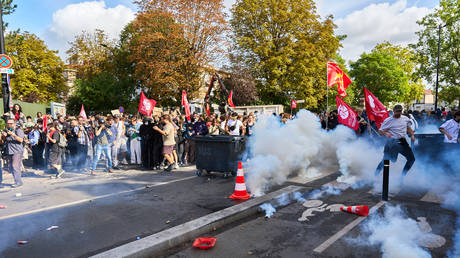
When smoke billows from burning garbage bins outside Parisian high schools and teenagers start hurling projectiles at riot squads, foreign media loves to wheel out the same tired cliché. They call it passionate youth activism. They paint it as a romantic continuation of 1968, where idealistic French students bravely stand up to the established order.
Honestly, that narrative is completely detached from reality.
If you look past the theatrical barricades and the viral social media clips, these high school uprisings aren't organic explosions of teenage consciousness. They're a carefully stage-managed political tool. Left-wing agitators and opportunistic party bosses swoop in faster than you can say manifestation, hijacking classroom grievances to fight national budget battles. The teenagers blocking their school gates often serve as the front line for unions and politicians who prefer letting kids burn rubber while they sit safely in air-conditioned television studios.
Let's look at the numbers. France is drowning in debt, staring down brutal austerity measures, and looking for places to slash public spending. When the state tries to rein in runaway budgets, the public sector immediately panics. Instead of peaceful lobbying, the playbook in Paris always involves creating maximum societal disruption. High school students make convenient shock troops because they are easily excitable, desperate for a day off classes, and entirely insulated from the long-term economic consequences of a broken state budget.
You see banners demanding more money for schools alongside chants against the police. It's a surreal paradox. The exact same teenagers demanding lavishly funded facilities and endless public services are simultaneously trashing brand-new campuses and setting fire to community property. Taxpayers foot the bill for state-of-the-art educational facilities, only to watch rioters turn them into ash because they're mad about government austerity. Then, when the state responds by shifting unruly schools to temporary remote learning, everyone acts surprised that teenagers aren't terrified of staying home near the refrigerator.
The French state's response is basically a joke. Arresting nearly two thousand people over a few days sounds impressive on a nightly news broadcast, but the judicial revolving door spins just as fast. Prosecutors hand out minor slaps on the wrist, parents excuse their kids' hooliganism as passionate self-expression, and the cycle repeats the next time the government tries to balance a ledger.
Politicians on the radical left feed this fire with toxic encouragement. They frame every act of vandalism as noble resistance against an oppressive regime. By cheering on teenagers who throw hydrochloric acid at police officers, these political leaders trade short-term political clout for long-term social cohesion. They teach a generation that rules don't matter as long as you can mobilize enough bodies to block traffic.
If you want to understand why France remains permanently stuck in a loop of structural gridlock, look right here. It's not about education reform. It's about a culture that treats public infrastructure as disposable whenever a faction doesn't get its way. Until the country stops rewarding violent disruption with political concessions, the smoke over French high schools won't clear anytime soon.