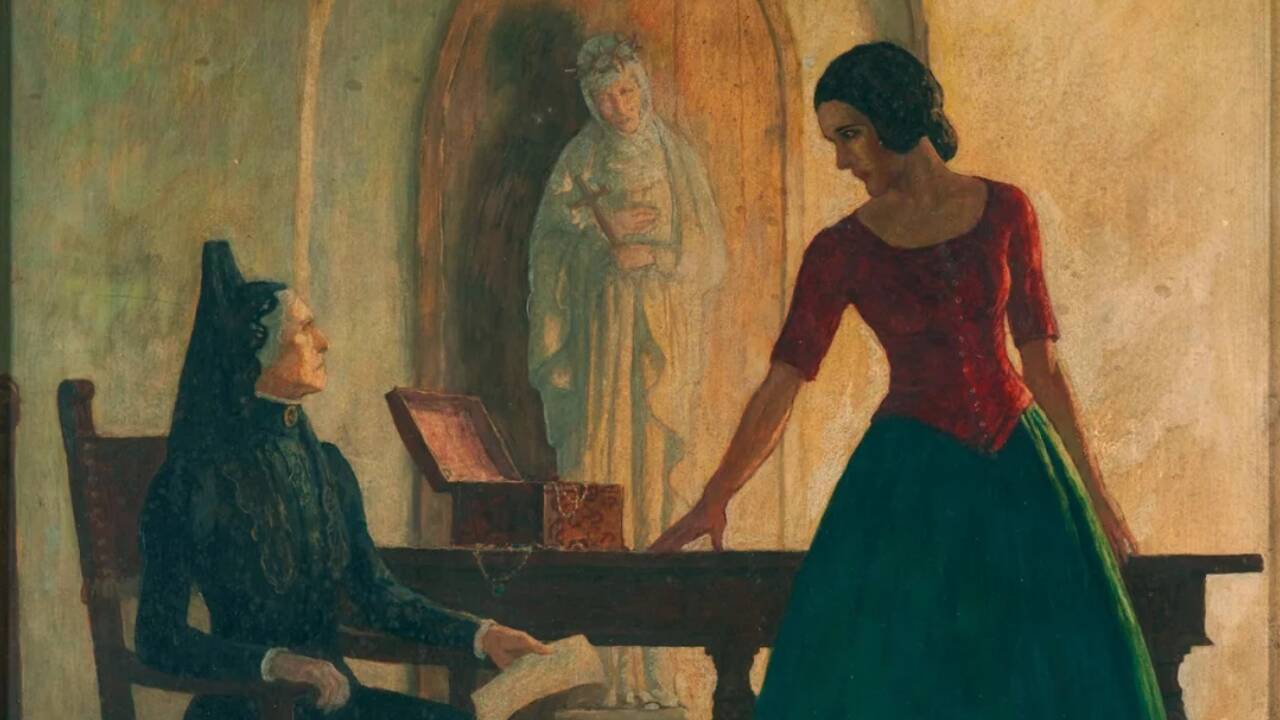
Most people dream about stumbling onto a hidden treasure at a local secondhand shop. You scroll through social media, spot a headline about someone turning pocket change into six figures, and wonder if your next Saturday garage sale crawl will change your life.
For Tracy Donahue of New Hampshire, that fantasy actually happened. But the real journey of her $4 thrift store find wasn't a clean, straightforward sprint to instant wealth. It involved a forgotten closet, a random Facebook post, a collapsed high-profile auction, and a frantic 3 a.m. phone call.
How a Four Dollar Frame Led to an N.C. Wyeth Masterpiece
Back in 2017, Donahue walked into a Savers thrift store in Manchester, New Hampshire. She wasn't hunting for fine art. She wanted a picture frame.
While digging through a stack of discarded posters and odds and ends, she spotted a heavy, dusty oil painting. It caught her eye because of the tense expressions on the faces of the two women depicted. She paid $4, tossed it into her cart, and took it home. At the time, store managers admitted they had zero idea what sat on their shelves. They process hundreds of donations airdropped by local residents, pricing items to clear space rather than authenticating historical artifacts.
Donahue hung the painting in her bedroom for a bit, then tucked it away in a closet. It sat there gathering dust for years. She did a quick, casual internet search early on and found nothing, so she simply forgot about it.
The Accidental Discovery That Changed Everything
Six years later, spring cleaning changed everything. In May 2023, Donahue pulled the canvas out of storage. This time, she flipped it over and noticed a signed label attached to the back.
Instead of keeping the clue to herself, she took a photo and uploaded it to a Facebook group called "Things Found in Walls". That single post triggered a chain reaction.
Art conservator Lauren Lewis happened to see the group post. Lewis had spent years working with art from the famous Wyeth family—spanning N.C. Wyeth, his son Andrew, and his grandson Jamie. Something about the brushwork on the screen grabbed her attention. She drove three hours to Donahue's house to look at the piece with her own eyes.
After close inspection, Lewis confirmed it was a genuine work by Newell Convers (N.C.) Wyeth, one of the twentieth century's most celebrated American illustrators. Specifically, it was a rare frontispiece illustration created in 1939 for Helen Hunt Jackson's novel Ramona. Out of four original illustrations Wyeth produced for that edition, most had vanished into history. This particular panel featured the main character alongside her rigid foster mother, painted on a distinctive Weber "Renaissance" panel with a red back.
When a Six-Figure Auction Falls Apart
By autumn 2023, the art world was buzzing. Bonhams Skinner scheduled the painting for an American art auction with an estimated value between $150,000 and $250,000.
When the hammer dropped, the high bid hit $150,000, stretching to $191,000 once the buyer's premium was factored in. Donahue and her family started planning a long-overdue vacation to visit their son living in Germany.
Then, reality struck hard. Weeks rolled by with no funds landing in the account. The winning bidder—joining remotely from Australia—simply vanished and never paid. The auction collapsed. The painting came back to the family, leaving them with an authentic masterpiece and zero cash. Donahue later called it her biggest disappointment ever.
How a Private Sale Salvaged the Win
Disaster avoided total heartbreak thanks to the tight-knit network of the art market. Aviva Lehmann, a specialist working with Heritage Auctions, caught wind of the failed auction drama through media reports.
Lehmann immediately knew a private collector who would jump at the chance to acquire a lost Wyeth illustration. In a moment she described as pure kismet, Lehmann dialed the collector at 3 a.m.—right as that exact collector was sending her a message asking about the painting.
The private transaction bypassed the public auction format entirely. The buyer secured the canvas for over $100,000. While lower than the phantom $191,000 auction bid, the funds actually transferred. The family finally received their payout, verified their accounts, and immediately called their son in Germany to tell him to clear his schedule.
What This Discovery Teaches You About Thrifting
People love to view stories like this as pure luck, but practical patterns emerge if you want to spot hidden value in everyday places.
- Look behind the art: Donahue found success because she turned the frame over. Signatures, gallery stamps, exhibition labels, and specific manufacturer panels (like Wyeth's preferred Weber boards) hold the clues that separate a worthless print from an original.
- Understand mass production vs. original media: Most thrift store art consists of mass-produced factory prints or decorative hotel canvases. Texture matters. Brushstrokes, canvas weave, and panel weight give away hand-painted works instantly.
- Utilize modern communities: You don't need a degree in art history to start investigating a find. Digital communities, niche social media groups, and local museum curators can help point you toward proper authentication channels.
Keep your eyes open during your next weekend thrift run. Just remember to check the backs of the frames before you check out.


:max_bytes(150000):strip_icc()/kimbap-korean-sushi-rolls-2118795-Hero_01-2453c846edd1449ab87c26761be72064.jpg)