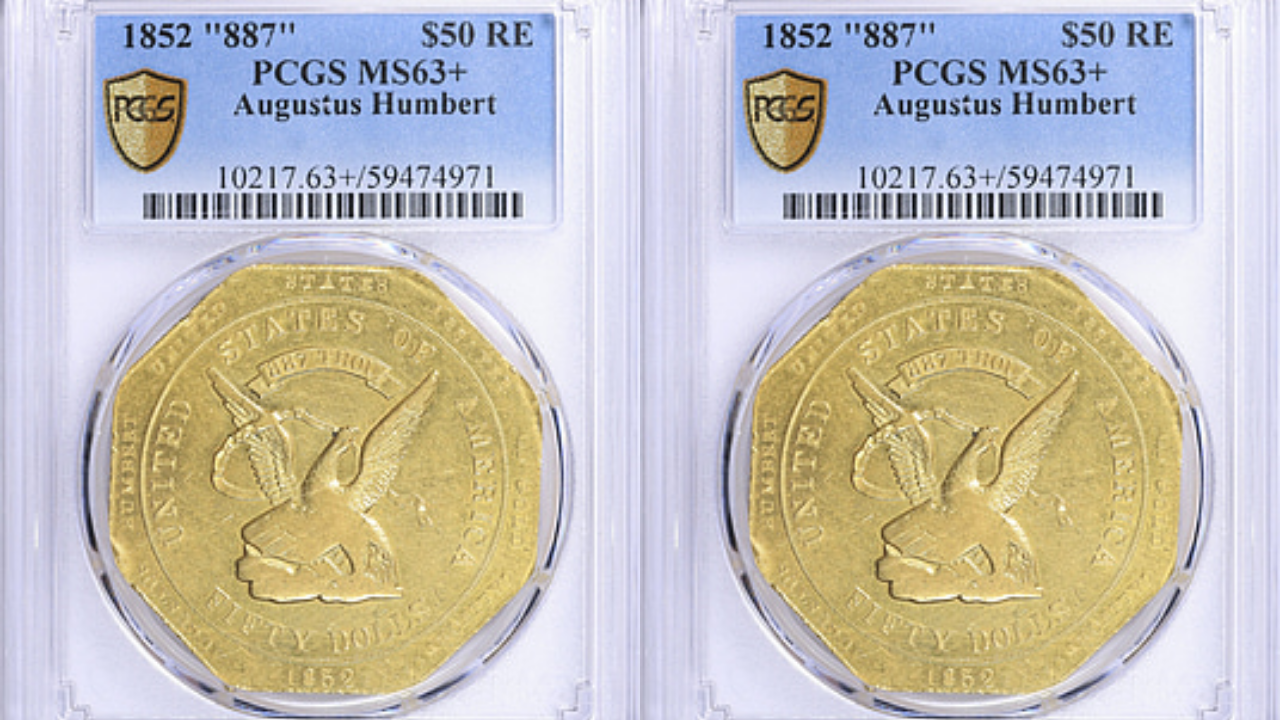
History has a funny way of paying dividends. When an 1852 California Gold fifty-dollar coin fetched a staggering $367,875 at auction, it proved that physical pieces of the Gold Rush era still command massive respect from modern collectors.
If you watch the rare coin market, you know territorial gold isn't just old currency. It's a tangible slice of frontier chaos.
The Story Behind the Rare Slug
Back in 1852, California was drowning in raw gold dust and nuggets, but short on actual official U.S. coins. Miners couldn't buy provisions with raw metal flakes. Private assayers stepped into the void, turning out heavy, oversized gold pieces that locals quickly nicknamed "slugs."
The star of the recent GreatCollections auction was an Augustus Humbert fifty-dollar piece, marked with the "887" fineness stamp. Humbert served as the official U.S. assayer in San Francisco during that chaotic era, validating the weight and purity of these massive octagonal tokens.
Most of these coins took a beating in everyday frontier commerce. They circulated through saloons, mercantile shops, and gambling dens, picking up heavy rim knocks and scratches. That is why finding one in top condition changes everything.
What Made This Particular Coin Worth $367,875
Graded PCGS MS-63+, this specific Humbert slug defied normal wear and tear. It landed two full grade points higher than any other known specimen of its exact variety.
When a piece of territorial gold retains pristine mint luster and sharp strike details after more than 170 years, numismatists take notice. This particular specimen even earned its place as a plate coin in Donald H. Kagin and David McCarthy’s reference work, America's Golden Age.
The auction performance was part of the broader Centennial Collection of Territorial Rarities. Across just eight certified coins, the auction block drew 475 competitive bids. Another heavy hitter from the same lineup—an 1852 Wass, Molitor and Company ten-dollar gold piece—pulled in $354,375.
Collecting Territorial Gold Today
If you are looking to enter the high-end numismatic market, territorial gold teaches a harsh lesson in supply and demand. You cannot simply walk into a local coin shop and expect to flip an eight-figure rarity for a quick profit.
Prices at the top tier are driven by three non-negotiable factors:
- Provenance: A documented paper trail linking the coin to historic collections or published literature adds massive credibility and value.
- Grade Preservation: Because these coins were heavy and awkward to carry, surviving high-grade mint state examples command exponential premiums over cleaned or worn counterparts.
- Variety Scarcity: Subtle punch differences, edge markings, and assayer stamps create extreme sub-categories where single-digit known populations dictate the price ceiling.
Authentication remains your biggest hurdle. Counterfeits and altered pieces have plagued the Gold Rush token market since the 1850s. Always insist on third-party certification from top-tier grading services like PCGS or NGC before putting serious capital on the line.
Keep your focus on quality over quantity. Securing one exceptional, well-documented piece always beats hoarding common, damaged scraps of history.